Author of the best-selling Muscle and Strength Pyramid books. I write no-nonsense nutrition and training guides. Join 100,000 others and download my Nutrition Setup Guide.
Why and How Bodybuilders Should Regain Fat Again After Competition
Before we dive in, two quick things:
First, congratulations to one of our former clients, Kobayashi, on winning the all-Japan ANNBBF bodybuilding competition last weekend and taking his pro card. (Yes, drug-free natural bodybuilding pros exist.)
Second, sharing a personal win — after 1.5 years of work translating, we released the Japanese version of The Muscle and Strength Pyramid: Training book this week, and got it to number 1 in the Amazon charts! 🎉😊
The success of these books in so many languages has surpassed even my wildest expectations. Thank you so much to those who have bought them. If you haven't and are interested, you can get digital copies here, or just search on Amazon.
Alright, onto today's topic, the next article in my series on diet adjustments...
Why and How Bodybuilders Should Regain Fat Again After Competition
This may shock some of you, but my advice to physique competitors after a contest is to get fat again.
I wish I could tell you that you could stay shredded all year, but you can’t. Your priority must be regaining body fat to healthy levels before trying to find maintenance or moving into a bulk phase.
So although the vast majority of my clients (and readers) do not compete, this short chapter is here to help explain why in the hope that you won’t be confused when you see seemingly conflicting advice.
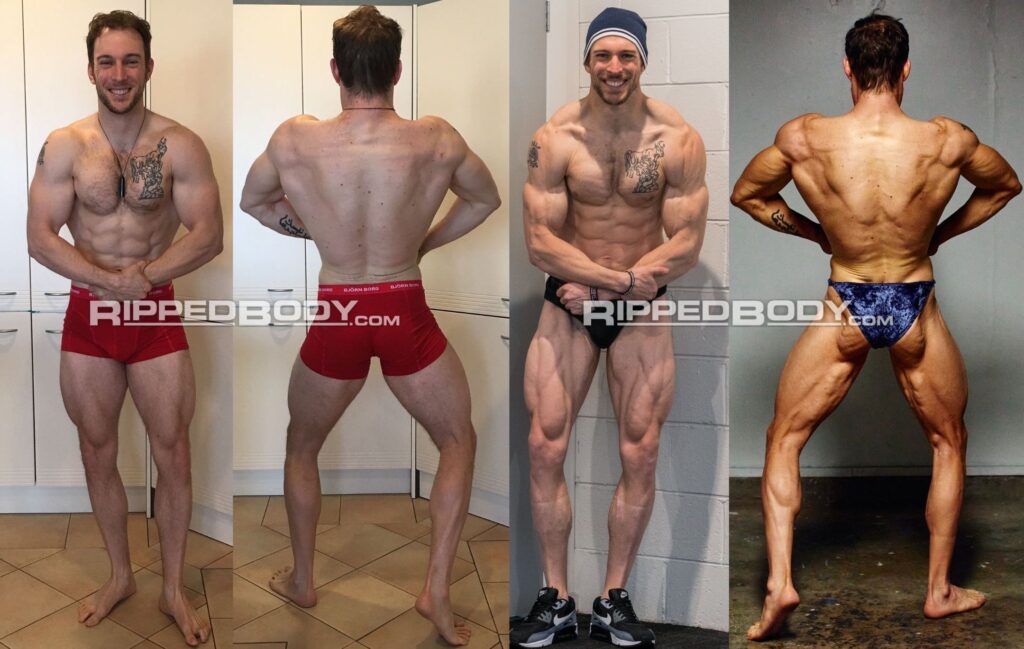 |
‘Recreationally lean’ (~11%) vs. ‘contest lean’ (~6%). Photo courtesy of my colleague Dr. Eric Helms.
Physique Competitors Need to Regain Body Fat to Healthy Levels
When I talked about minimizing fat regain when transitioning to maintenance in the previous chapter, I was speaking to the majority of those reading this book, who will end their cutting phase somewhere around 10–11% body fat.
As a reminder, here’s roughly how the lower body fat percentages look for recreational trainees:
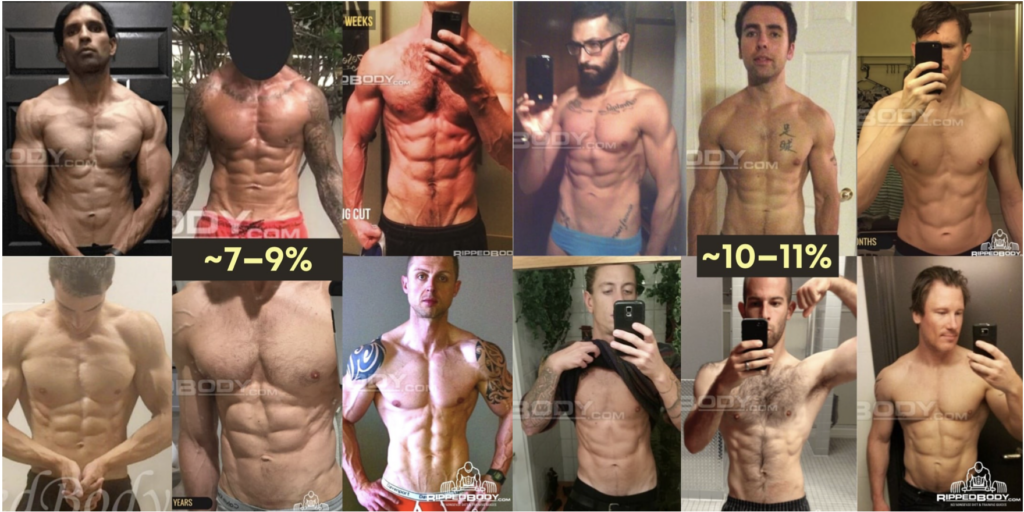 |
‘Recreationally lean’ clients at the end of their cut phases. The 7–9% range (left) is significantly harder to sustain than 10–11% on the right.
As you can see in the client photos, this still looks shredded lean, but physique competitors need to get significantly leaner (down to 4-6% body fat) to stand a chance of winning, and there is a world of difference in the level of suffering someone has to go through to get there. Dieting is controlled starvation, but bodybuilding prep is controlled starvation taken to the extreme. Your body will fight you with extreme hunger, fatigue, and (usually) complete loss of libido.
The majority of the differences between ‘recreationally lean’ and ‘competitively lean’ people aren't clear from shirtless front photos because the last fat comes predominantly from the legs, lower back, and bum.
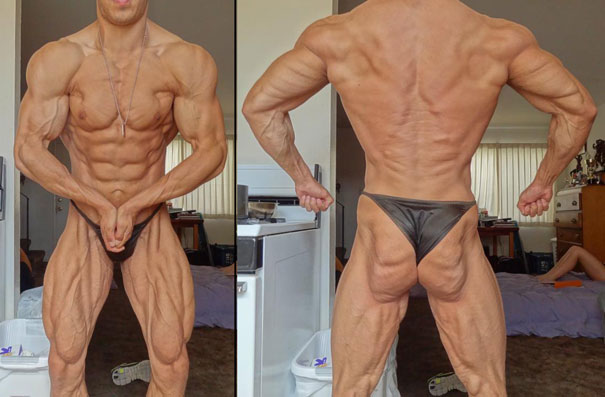 |
‘Contest-level lean.’ — Alberto Nunez at 5-6% body fat.
This means two things:
- Nobody accidentally diets themselves into contest conditioning.
- The reward isn't worth the effort for those who don’t plan on competing.
Some people can maintain 9–11% body fat for extended periods, even year-round (hunger signals and environment play a large role here), but it is not possible to maintain a stage-shredded 4–6% body fat for any length of time without health consequences.
So to be clear:
The goal of the recreational trainee, after they have finished dieting, is to sustain their current level of leanness or bulk, while minimizing fat regain.
But the goal of the physique competitor after a competition must be first to get back to a healthy level of body fat. Only then should they consider maintenance or moving into a bulk while minimizing fat regain.
How to Regain Body Fat to Healthy Levels
I recommend that you adopt the mindset that the contest prep ends when you are back to a healthy state, not when you step off the stage.
But how do you know when you’re back at a healthy body fat range, given that we can’t assess body-fat percentage accurately? It’ll be once you’ve gained 5-10% of your body weight when the fat regain and increases in water, gut content, and glycogen are all considered.
- Aim to gain 5–10% of your stage weight in 4–8 weeks.
- If you gained more than 10% in 4 weeks and feel that the upward trend will continue, you might want to be more mindful of your intake.
It’s hard to say what the best approach to this is. Should you continue to count calories or not?
You want to eat enough to get back to a healthy body fat range without binge eating. Ideally, you’ll do this without needing specific calorie targets. But for many people, their internal hunger and fullness cues have been so disrupted that they’re unable to control their intake without concrete targets to hit. If you know that you are going to be unable to control yourself without counting, use the calculations below:
- After the contest, estimate your deficit based on your latest weight loss rates. Add it to your intake.
- Add a calorie amount equivalent to your stage weight in pounds × 5–8 (or stage weight in kg × 10-16).
Use the lower end of the range if you were fairly lean before the diet. Use the higher end of the range if you had a fair amount of fat before the diet or you feel you are about to lose control after the contest.
Example: If you have been losing 0.75 lbs per week up until your competition, your stage weight is 150 lbs, and you dieted from 190 lbs (which can be considered a lot), add 1575 kcal.
(0.75*500 + 150*8)
If you were eating 1600 kcal/day at the end of your contest prep, this means you’ll target 3175 kcal/day. Here’s how to do it:
- Make the most of the healthy eating habits that you’ve developed through the dieting period by increasing the quantities of the foods you’ve been eating rather than changing your diet dramatically. You can increase variety, and add some of your favorite foods, but do not let go of your eating habits entirely.
- If you find yourself binging, do not blame yourself. You’re physiologically driven to eat, and that’s natural. What is important is you do not let binging become a habit.
- At the end of weeks 4, 6, and 8 assess your body weight recovery, and how you feel in terms of food focus, binging, mood swings, irritability, energy levels, and gym performance. If you experienced problems with any of these towards the end of the diet, they likely won’t vanish the minute you step off the stage. Some may linger even after you’ve gained 10% of your stage weight but pay attention to whether they are improving.
- When you’ve gained 10% of your stage weight and/or you feel healthy enough in terms of the potential problems above, follow the instructions for the transition to a bulk or maintenance.
Thank you for reading. Questions welcomed, as always.
Have a wonderful weekend!
RippedBody.com
Author of the best-selling Muscle and Strength Pyramid books. I write no-nonsense nutrition and training guides. Join 100,000 others and download my Nutrition Setup Guide.
If you've checked out any of our free training programs this year, you may have noticed a shift: Our bodybuilding programs now use RIR (Reps in Reserve) instead of RPE (Rating of Perceived Exertion) to guide training intensity. Why the change? RIR has become more common in bodybuilding circles, and as we updated the new edition of The Muscle and Strength Pyramid: Training, it made sense to follow suit. To explain what this means, why it matters, and why we’ve mostly moved away from...
In the last email, I talked about the hierarchy for stress management — one of the four pillars of physique change. Today, I want to talk about training. When it comes to training, we’re often taught to focus on the wrong things — flashy techniques over foundational principles that drive results. That’s because the most important levels — adherence, volume, and intensity — aren’t catchy, and they require nuance. The Training Pyramid has six levels. Here's our most up-to-date version, which...
In the last email, I talked about the hierarchy of importance for sleep, one of the four pillars of physique change. Today, I want to discuss stress. There are six levels to the stress hierarchy pyramid: Let's dive in! 1. Total Stress Load and Adaptive Reserve At the top of the hierarchy is the total amount of stress you are coping with. This is not just what you do in the gym, but everything you experience outside the gym as well (work, relationships, sleep loss, calorie deficits, etc.). All...